

Kristopher earned his J.D. at the University of Southern California Gould School of Law where he was a member of the Review of Law and Social Justice honors law journal and was awarded several scholastic honors.
An estimated 1.7 to 3.8 million people suffer a traumatic brain injury each year in the US. If someone else’s negligence caused your TBI, you could pursue compensation for your damages.
But what’s the average settlement for a brain injury in California?
I asked my team at Peerali Law to review 100 traumatic brain injury cases in California, and we found the average TBI settlement is $6,058,978.
That’s not the full picture, though. The range runs from $75,000 to $65,750,000. Several cases in our dataset resolved for over $30 million — and when those outliers are removed the average TBI settlement in California falls to $2,380,000.
In this article we’ll look at 12 key factors that determine how much your TBI case could be worth.
Disclaimer on selection bias: All 100 cases were published by leading California law firms on their results pages. Firms publicise wins, not losses — the true average across all California TBI cases is likely lower. These figures represent outcomes achievable with strong legal representation.
In this article you’ll see:
- Why the average TBI settlement figure alone tells you very little about what your case is worth
- The 6 factors that push TBI settlements up — with real case data behind each one
- How TBI settlements vary across 5 types of car accident in California
- The single factor that most often suppresses compensation, regardless of injury severity
What You Need to Know Before Looking at TBI Settlement Averages
Traumatic brain injury settlements are not a lottery. In most personal injury cases, you first sue the individual or business responsible for your injury. Their insurance company then pays for the defence and any resulting settlement or judgment.
On January 1, 2025, California increased its minimum bodily injury liability coverage from $15,000/$30,000 to $30,000 per person and $60,000 per accident. Many drivers carry only that minimum.
In my experience — particularly with TBIs caused by car accidents — approximately 95% of cases involve civilians covered by policy limits of $100,000 or less. That matters enormously.
Even if your TBI case is genuinely worth $500,000 or more, you may only be able to recover up to the at-fault driver’s policy ceiling.
Are There Exceptions?
Yes, there are lots of exceptions.
Government bodies, corporations, and individuals with significant personal assets may carry umbrella policies providing millions in additional coverage. If damages exceed all available insurance, you can pursue the defendant’s personal assets — property, savings, or other holdings — to satisfy the remaining judgment.
But for the majority of California TBI victims, the defendant’s policy limit is the practical ceiling on recovery.
How Can I Know the Defendant’s Insurance Policy Limit?
Here’s something most people do not realise: in the vast majority of cases I have handled, neither the plaintiff nor the defendant knows what the defendant’s insurance policy limit actually is. The defendant often does not know their own limit. The only way to find out is for an attorney to file a formal demand letter, which compels the insurer to disclose it.
If you have suffered a TBI and want to know the defendant’s policy limit in your case, contact Peerali Law.
We will review your case and file a demand letter at no cost to you. We operate on a no-win, no-fee basis — you pay nothing unless we secure your settlement.

12 Things That Determine Your TBI Settlement Value in California
Factor 1: Going to Trial Dramatically Raises Awards
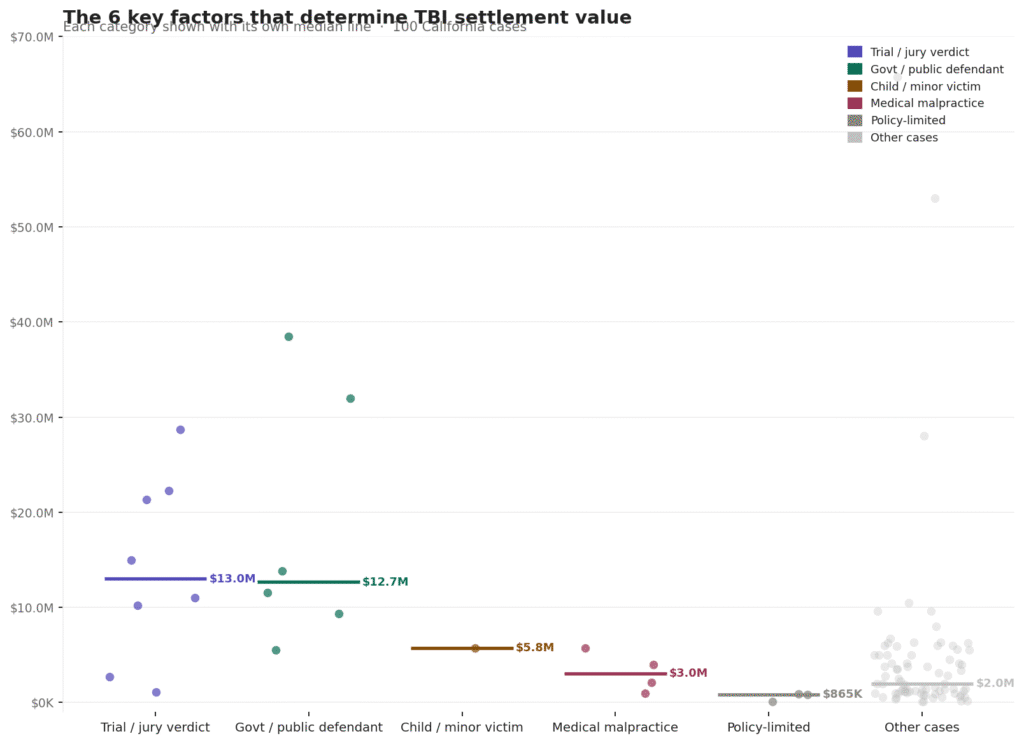
Our data found that trial verdicts average $10,344,240 compared to $2,990,849 for confidential settlements — a difference of 3.5 times. Going to trial is the single clearest lever in our dataset.
The median figures reinforce the same picture. Trial verdicts produced a median of $8,115,000. Confidential settlements produced a median of $1,450,974. Across 14 trial verdicts and 63 confidential settlements in our dataset, the pattern is consistent.
This does not mean every TBI victim should go to trial. Trials carry risk, cost, and time. But the data makes clear that defendants — and their insurers — settle cases for significantly less than juries award them.
Real cases from our dataset:
- $28.7M — A Los Angeles jury awarded $28.7 million after an anesthesiologist used the wrong anaesthesia type during throat surgery, leaving the plaintiff with an anoxic brain injury.
- $21.3M — A jury verdict against Services Group of America after a commercial tractor-trailer slammed into a woman who had stopped to make a left turn.
- $16.4M — A jury awarded $16.4 million against Caltrans after a tree branch from state right-of-way fell on a motorcyclist on State Route 79, causing a brain bleed.
What does this mean for your TBI case worth?
If the defendant’s insurer is offering a confidential settlement that feels low, our data suggests juries award significantly more for serious TBI cases. Whether going to trial is the right strategy depends on the specific facts of your case — but it is a lever worth understanding.
Factor 2: Government or Public Entity as Defendant
We found that cases against Caltrans, LA County, state agencies, and public transit average $12,578,750 — compared to $5,169,918 for all other defendants. That is 2.4 times the baseline, across 12 cases in our dataset.
The median tells the same story: $7,800,000 for government defendants versus $1,975,000 for all others. Public entities often carry no insurance ceiling in the way an individual driver does. Institutional negligence also tends to produce stronger jury responses.
Real cases from our dataset:
- $38.5M — A 990-ton bridge deck collapsed during the SR-91 Corridor Improvement Project in Corona, causing traumatic brain injuries — Caltrans named as defendant.
- $32M — A confidential settlement after Tulare County’s failure to respond to child abuse reports resulted in permanent brain damage to a child.
- $13.8M — An LA Metro bus struck a parked car transporter, throwing a passenger around the interior — settled against LACMTA.
What does this mean for your TBI case worth?
If the defendant in your case is a government body, public transit authority, or state agency, you may be entitled to significantly more compensation than the average TBI settlement suggests. Government defendants do not carry the same insurance constraints as private individuals.
Factor 3: Injury Severity Is the Strongest Individual Predictor
Severe, permanent, or anoxic TBI cases averaged $7,679,494 in our dataset. Mild TBI cases in California saw an average settlement of $1,690,857 in our data. The gap is 4.5 times — and it’s the largest single-factor spread driven by the victim’s injury alone.
However, mild TBI cases with compounding factors still reached $2 million to $5.75 million in our dataset. Severity matters, but it does not operate in isolation.
Real cases from our dataset:
- $5.75M — A 16-year-old developmentally disabled child suffered a mild TBI after being struck by a bus in a crosswalk. The vulnerability of the victim and clear liability drove a confidential settlement of $5.75 million despite the mild classification.
- $4.5M — A mild TBI in a freeway crash with a delivery vehicle — a commercial defendant with clear liability — produced a result of $4.5 million.
- $2.7M — A straightforward mild TBI case taken to trial reached $2.7 million, illustrating how going before a jury elevates outcomes regardless of severity.
What does this mean for your TBI case worth?
A mild TBI diagnosis does not mean a modest settlement. If your case involves a commercial defendant, a government entity, or a vulnerable victim, the severity classification is only one part of the picture.
Factor 4: Vulnerable Victims — Children and the Elderly
My team found that TBI cases involving minors averaged a settlement of $8,647,143 — compared to $5,864,170 for all other victims. The median for child victim cases is $4,500,000, against $2,000,000 for all others. Courts and juries treat a child’s lifetime of lost potential as a significant multiplier on damages.
Real cases from our dataset:
- $32M — Tulare County’s failure to respond to child abuse reports resulted in permanent brain damage — institutional negligence against a child victim drove an exceptional outcome.
- $22.25M — A jury awarded $22.25 million after a young boy on a bicycle suffered major brain damage when a car exited a shopping centre rear lot in Los Osos.
- $5.75M — A 16-year-old developmentally disabled child struck by a bus in a crosswalk settled for $5.75 million despite a mild TBI classification, due to age, disability, and clear liability.
What does this mean for your TBI case worth?
If the TBI victim is a child or elderly person, California courts and juries have consistently awarded above-average compensation. The duty of care owed to vulnerable victims is treated as a meaningful factor in determining damages.
Factor 5: Medical Malpractice TBI Cases Outperform Most Accident Types
Medical malpractice TBI cases average $7,747,044 in our dataset — higher than the general car accident average of $6,155,828. The median for malpractice cases is $4,750,000, against $2,000,000 for general car accidents. Hospital and anaesthesia failures tend to involve well-insured institutional defendants, and juries respond harshly to medical negligence.
At Peerali Law, we secured a $2.1 million settlement in a medical malpractice case in which an infant suffered severe brain damage due to an undiagnosed condition at discharge. You can see more of our case results here.
Additional cases from our dataset:
- $28.7M — A jury awarded $28.7 million after negligent anaesthesia during throat surgery in Los Angeles left the plaintiff with an anoxic brain injury.
- $11M — A jury verdict against Anesthesia Service Medical Group, Inc. following severe brain injury during a medical procedure.
- $5.7M — A San Francisco hospital’s failure to order a C-section in time caused catastrophic brain injury to a newborn, settling confidentially for $5.7 million.
What does this mean for your TBI case worth?
If your TBI was caused by a hospital, surgeon, or anaesthesiologist, the defendant is likely an institution with substantial insurance coverage. Medical malpractice TBI cases consistently produce above-average outcomes in our data.

Factor 6: The Type of Car Accident Affects Your Settlement
Across 92 car accident cases in our dataset, the mean TBI settlement is $5,912,190 and the median is $2,000,000. But the type of crash — and more importantly, the type of defendant involved — produces dramatically different outcomes across five sub-categories.
Crash Type 1: Bicycle Accidents — Highest Median of Any Sub-Type
Mean: $7,791,000 | Median: $5,900,000 | Cases: 5 | Range: $75,000–$22,250,000
Liability in cyclist-versus-driver cases is almost always clear. Juries are sympathetic. Impacts tend to produce severe injuries. The $75,000 floor case — a San Francisco dooring incident — almost certainly reflects a policy-limit ceiling, not the assessed value of the injury.
Real cases from our dataset:
- $22.25M — A cyclist rear-ended by a driver acting in the course of their employment — vicarious employer liability gave the plaintiff a deep-pocketed defendant — resulted in a jury award of $22.25 million.
- $10.23M — A young boy struck by a car exiting a shopping centre received $10.23 million at trial for major brain damage.
- $75,000 — A San Francisco cyclist doored by a parked car received $75,000 — a textbook policy-limit outcome where the at-fault driver almost certainly carried minimum coverage.
What does this mean for your TBI case worth?
Bicycle accident TBI cases produce the highest median of any crash type in our dataset. If you suffered a TBI in a cycling accident, contact a TBI attorney to assess the defendant’s assets and insurance before assuming your recovery is limited.
Crash Type 2: General Car Accidents — Largest Sub-Type, Widest Range
Mean: $6,155,828 | Median: $2,000,000 | Cases: 67 | Range: $120,000–$65,750,000
The broad category masks enormous variance. Outcomes are driven almost entirely by defendant type — commercial versus private, government versus individual — and whether the case goes to trial. The crash mechanism itself is the least predictive variable.
Real cases from our dataset:
- $65.75M — The largest case in our dataset is a general car accident TBI case — minimal case notes are available, but the scale reflects a high-asset or commercial defendant.
- $9.35M — A defective temporary traffic signal operated by the City of Los Angeles produced a $9.35 million confidential settlement after a driver ran the malfunctioning signal.
- $192,500 — A case with a nearly identical crash mechanism to the multimillion-dollar cases above, but a private individual defendant with standard insurance limits, settled for $192,500.
What does this mean for your TBI case worth?
Two car accident TBI cases with identical injuries and crash mechanics can produce outcomes that are 50 times apart. The defendant’s identity and insurance position matter more than how the accident happened.
Crash Type 3: Pedestrian Accidents — Outcome Entirely Dependent on Defendant Assets
Mean: $5,890,143 | Median: $1,950,000 | Cases: 7 | Range: $250,000–$28,000,000
Liability is usually clear in pedestrian cases. But outcomes hinge almost entirely on what the defendant actually has in insurance and personal assets. One case in our dataset explicitly notes in the record that “the defendant had assets” — cited by the attorney as the reason a $6 million trial was worth pursuing.
Real cases from our dataset:
- $28M — A confidential settlement with minimal case notes — the scale almost certainly reflects a high-asset or corporate defendant.
- $6M — A homeless man struck in a crosswalk at night received a $6 million jury verdict specifically because the defendant had assets — a detail explicitly noted in the case record.
- $250,000 — A pedestrian struck at an intersection settled for $250,000 — limited to the at-fault driver’s standard policy.
What does this mean for your TBI case worth?
If you were struck as a pedestrian, the first step is identifying whether the defendant has assets or coverage beyond a standard minimum policy. That single determination shapes whether your case is worth $250,000 or $28 million.
Crash Type 4: Freeway and Highway Crashes — Nearly Double Surface-Street Cases
Mean (freeway): $7,504,333 | Median (freeway): $5,000,000 Mean (surface street): $5,602,032 | Median (surface street): $1,895,000 Cases: 15 freeway / 77 surface street
Higher speeds produce more severe injuries. But the bigger driver of elevated freeway outcomes is defendant composition — freeway crashes more often involve commercial vehicles, Caltrans infrastructure liability, or multi-party defendants. Three separate cases in our dataset name the State of California as a co-defendant in freeway TBI cases.
Real cases from our dataset:
- $38.5M — The collapse of a 990-ton bridge deck during the SR-91 Corridor Improvement Project in Corona — Caltrans named as defendant — produced a $38.5 million verdict.
- $9.6M — A 1,000-lb tow dolly that detached from a delivery truck mid-travel caused a violent collision, settling for $9.6 million.
- $6.25M — A Halliburton employee lost control on I-5, with both the corporation and the State of California named as defendants, settling for $6.25 million.
What does this mean for your TBI case worth?
If your TBI occurred in a freeway or highway crash, the probability of a commercial or government co-defendant — and therefore a significantly higher recovery — is meaningfully greater than in a surface-street collision.
Crash Type 5: Rear-End Accidents — Same Crash, 47× Spread in Outcomes
Mean: $4,361,875 | Median: $940,000 | Cases: 8 | Range: $450,000–$21,300,000
The gap between mean and median tells the real story. One commercial tractor-trailer verdict pulls the mean up while the majority of cases — private individuals with standard insurance — cluster below $1 million. The crash type is identical across all eight cases. The defendant is everything.
Real cases from our dataset:
- $21.3M — A jury awarded $21.3 million after a Services Group of America tractor-trailer slammed into a woman stopped to make a left turn — a commercial defendant taken to trial.
- $6M — An LACMTA bus rear-end on a freeway settled for $6 million — a government defendant, without going to trial.
- $450,000–$600,000 — Two rear-end cases involving private individuals with mild TBI injuries settled confidentially for $450,000 and $600,000 respectively.
What does this mean for your TBI case worth?
If you were rear-ended by a commercial vehicle or government-operated transport, your case occupies a fundamentally different category to a standard rear-end collision — even if the injuries appear similar.
Important: The One Factor That Suppresses TBI Compensation
Insurance policy limits are the single most powerful downward force on TBI settlements in California.
A victim can have catastrophic, permanent injuries and still receive a fraction of their true damages if the at-fault party carries only minimum coverage — or if their own uninsured/underinsured motorist (UIM) policy is their only recourse.
In our dataset, cases where only capped policies were available averaged a median of $880,000 — compared to $2,700,000 for all other cases. The mean for policy-limited cases was $1,774,000, against $6,284,503 for all others. This factor is almost certainly underrepresented in published data. Law firms publicise wins. Cases that hit policy limits are often their smallest recoveries.
Real cases from our dataset:
- $120,000 — A 78-year-old struck by a golf ball at a city-run course suffered a TBI that left him partially paralysed. Despite catastrophic, permanent injury, the jury awarded only $120,000 — almost certainly reflecting a government liability cap, not the assessed value of the claim.
- $125,000 — A client suffered a TBI in a serious collision but recovered only $125,000 — limited entirely to her own UIM coverage, because the at-fault driver carried no usable insurance.
- $2,000,000 — Attorneys representing a three-year-old child struck while being carried across the street exhausted every available policy: $1.25 million from the driver’s auto insurer, $500,000 from homeowners insurance, and $250,000 in third-party recovery. The $2 million total represents the ceiling of every available policy — not the true value of the child’s injuries.
What does this mean for your TBI case worth?
If the defendant carries only minimum insurance, your recovery may be capped well below what your injuries are truly worth. The only way to know the defendant’s policy limit is for an attorney to file a demand letter. Most plaintiffs — and most defendants — do not know this figure until that step is taken.
Contact Peerali Law for a Free Case Review
Understanding what drives TBI settlements is one thing. Knowing where your specific case sits within that picture requires expert legal analysis.
At Peerali Law, Kristopher L. Peerali has secured multi-million-dollar results for TBI victims across California — including a $16.3M premises liability verdict and a $5.2M car accident settlement. With a J.D. from USC Gould School of Law and admission to the California State Bar since 2018, he leads the firm’s catastrophic injury and trial litigation practice.
We will review the details of your case and file a demand letter to uncover the defendant’s policy limits. It will cost you nothing. We operate on a no-win, no-fee basis — you pay nothing out of pocket unless we secure your settlement.